


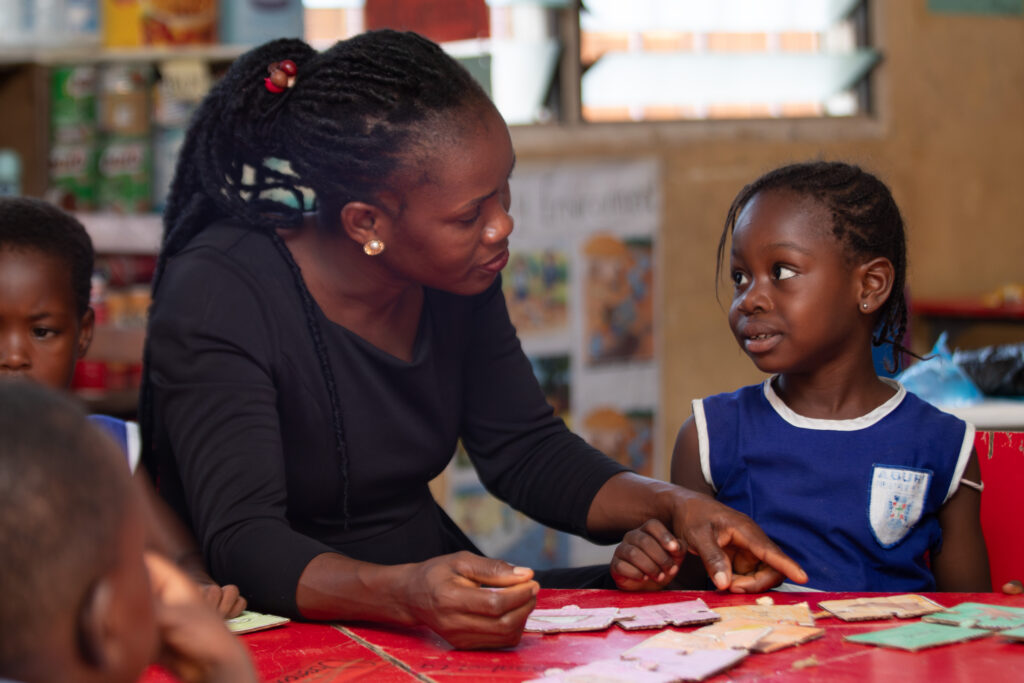
For many children in Ghana and across Africa, their formal education begins in a kindergarten (KG) classroom taught by a woman. Female educators are at the heart of Early Childhood Education (ECE), laying the foundation for lifelong learning.
Despite being one of the most impactful stages of education, ECE is often undervalued, with many female KG teachers lacking formal training, support, and fair recognition. This International Women’s Day, under the theme Accelerate Action, we highlight the crucial role of female educators and the urgent need to invest in their professional development.
Challenges Facing Female Early Grade Educators in Ghana
In Ghana, more than 80% of KG teachers are women, making them key drivers in shaping early learning experiences. Their role extends beyond learning outcomes—play-based early education helps children develop social skills, emotional development, and a strong foundation for their education through primary and junior school [UNICEF].
While Ghana has made significant progress in early years education, major challenges still impact KG teachers nationwide:
- 85% of teachers trained manage KG classrooms with limited knowledge on play-based learning [GES].
- Classroom sizes vary significantly in kindergarten classrooms where the majority of teachers are female— for example, the national pupil-teacher ratio is 30:1, but in Savannah and Northern Regions (and under-resourced urban communities), it rises to 42:1 (EMIS; 2023), straining resources and teacher capacity.
- Inadequate classroom infrastructure and a lack of play-based teaching and learning resources frequently impact teachers ability to educate through play.
- Gender disparities in teaching positions show a clear imbalance, reflecting a hierarchy in teacher-level status:
- Kindergarten: 84.9% of teachers are women. [UNESCO UIS]
- Primary Education: 45% female teachers. [UNESCO UIS]
- Secondary Education: Women make up only 26.4% of teachers. [World Bank].
Supporting Female Educators: Government Progress
The Ghanaian government has made strides in promoting gender equality in education through key policies aimed at ensuring inclusive access, supporting female educators, and removing barriers to girls’ education. The Inclusive Education Policy (2015) aims to ensure equitable access for all learners, including those with special needs [SAP Ghana]. The Gender Equality and Social Inclusion (GESI) Strategy integrates gender considerations into education policy, fostering a more inclusive learning environment [GTEC]. Additionally, the Girls’ Education Unit (GEU) works to remove barriers to girls’ education and increase the representation of female teachers, further strengthening gender equity in the education sector.
Sabre Education: Strengthening Kindergarten Teaching
To complement these efforts, Sabre Education, in collaboration with the Ghanaian government and partners, is actively supporting early grade teachers through targeted interventions:
- Scaling gender-responsive, play-based teacher training to public and private early grade teachers, headteachers and local government education officials.
- Expanding professional development of early grade student teachers through partnerships with colleges of education.
- Strengthening peer-to-peer KG teacher support through Professional Learning Communities.
- Improving school infrastructure for KG classrooms in under-resourced regions.
- Advocating for systemic change—ensuring government, funders, and NGOs prioritise ECE and teacher support.
- Building community support of teachers & schools through Leadership Communities of Practice.
“By training thousands of early grade teachers, the majority of them being women, Ghana is not only transforming early learning but also empowering female educators to become champions of change in their communities.”
Margaret Brew-Ward, Senior Manager Advocacy & Policy Engagement, Sabre Education
Accelerating Action: How You Can Help
Funders: Investing in early years education and supporting women in the sector can help shape a stronger future for Africa.
Parents & Communities: Strengthening connections with teachers and advocating for girls’ education can enhance learning outcomes for all children.
Governments: Providing infrastructure, quality training and resources for early grade teachers, especially in underserved regions, can improve early childhood education.
NGOs & Researchers: Expanding collaboration on play-based learning and strengthening research on gender-responsive education can drive meaningful change.
Individual: Promoting early childhood education as the foundation of learning, highlighting women’s vital role, and advocating for greater support from parents, headteachers, and government.
This International Women’s Day, let’s Accelerate Action and champion women in early education. Investing in female educators means investing in Africa’s future, creating a more equitable and prosperous society for all.
_
References for this article:
- UNICEF: https://data.unicef.org/topic/early-childhood-development/early-childhood-education/
- GES: 2024 KG Fact Sheet
- UNESCO UIS: https://databrowser.uis.unesco.org/
- World Bank:https://data.worldbank.org/indicator/SE.SEC.TCHR.FE.ZS?locations=GH
- SAP Ghana: Inclusive Education Policy
- GTEC: National Gender Equality and Social Inclusion (GESI) Strategy
