Story sharing from books or from memory is a very important part of kindergarten life. It is a fun and enjoyable activity and children can learn so much from stories.
Stories help children to learn not only facts and information but also to gain an understanding of others’ feelings and ways of behaving. They also help to increase vocabulary and demonstrate sentence structure. Story sharing is important for the development of language as well as for building children’s imaginations and creativity.
Here are some of the key skills that children can develop through story sharing that will support them to become effective learners:
- listening
- rhyming
- remembering
- sequencing
- vocabulary
- imagining
Storytelling happens every day in the kindergarten schools we work with, and each classroom has a Book Centre which is a perfect place for exploring books. Teachers are encouraged to make storytelling special, here are just some of the ways teachers do this:
- A storyteller’s hat – a special hat for storytelling
- A storyteller’s chair – a specially decorated chair just for storytelling
- A storyteller’s cloak – a special cloak worn only for storytelling
- A storytelling mat – so that storytelling is done in a specific area.
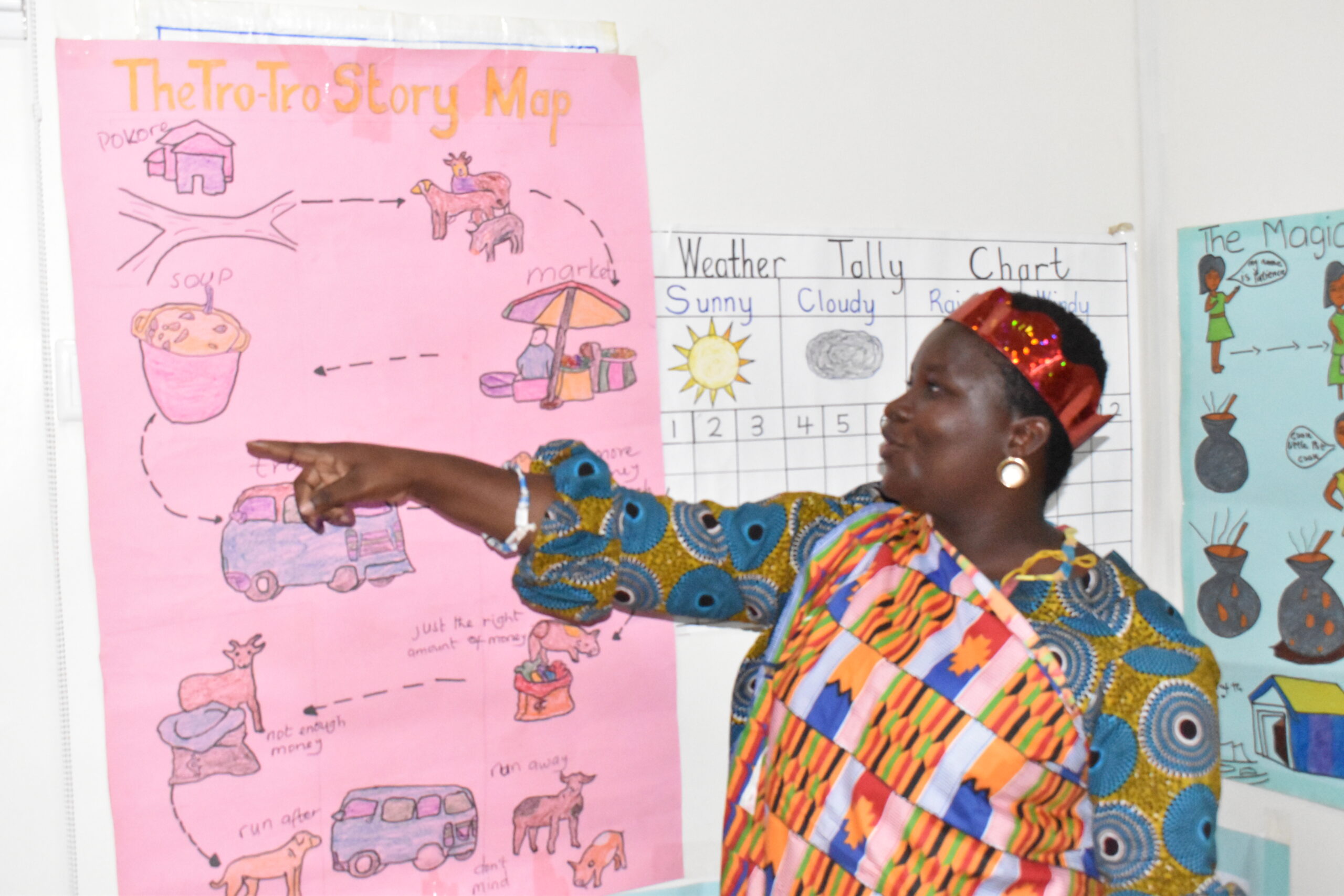
Stories can be told by reading from story books, from memories or using imagination to create a new story. A key tool teachers use to bring their stories to life is a story map.
Story maps:
- support children’s attention while the story is being told
- helps recall of the story
- supports children to retell stories to each other using the pictures
- helps to develop sequencing skills.
Some top tips to bring stories to life
Use your voice – our voice is like a musical instrument; you can make it loud or soft; you can speed up or slow down the reading according to the mood of that part of the story. Use pauses to allow time for children to absorb a new idea. Different voices can be used for different characters, and animal noises are great to use in stories that feature animals.
Involve your audience – Children can be encouraged to make appropriate noises, such as stamping their feet for thunder. They can join in with repetitive phrases, such as he went higher and higher, or counting. Children can respond to the expression of feelings, by facial expressions or gestures.
Provide real objects – such as hats, clothes, baskets and cooking pots, or make clay and papier mâché model items and masks for children to use when retelling or acting out the story themselves. Puppets are a great resource too and can be used as story characters (i.e. finger puppets made from socks or fabric and stick puppets decorated with cloth, paper and colours). These all add to children’s involvement.
Use drama – drama follows naturally from storytelling and helps children to get to know the language and the story’s narrative really well.
- You can use actions to add meaning to words
- Encourage role-playing which gives children the opportunity to go over scenes in the story or to create new ones
- Allow children to act the story out as it is being told
- Objects from a story can be placed with a group of children so that they can decide what happens in the story or to a particular character in the story.
Story sharing in action
Here’s the Tro-Tro story, told by our Training Officer, Lucy Ama Berma. Notice how Lucy uses a number of our top tips, including wearing the special storytelling hat and cloak, incorporating different sounds, using different voices, gestures and actions, all delivered with a smile and lots of enthusiasm to capture children’s imaginations and bring the story to life. We hope you enjoy it!